 Klimadao
 treasury: legacy backing and ownership
KlimaDAO’s original treasury combined tokenized carbon reserves with liquidity assets supporting KLIMA markets on Polygon PoS. Its carbon-backing measure described reserves per token; it did not by itself establish a market price or a holder’s withdrawal entitlement. The newer Klima Protocol on Base uses a retirement-focused carbon inventory, and holding kVCM or K2 grants no ownership or redemption rights over that carbon.
What backed KLIMA in the original model
The legacy KLIMA documentation described each KLIMA as backed by at least one carbon tonne in the treasury. It also stated that minting a new KLIMA required locking a tonne of digital carbon there.
- Digital carbon reserves
- Tokenized carbon credits held as the original treasury’s reserve assets. Their quantity supplied the carbon-tonne measure used in the backing description.
- Liquidity assets
- Liquidity acquired to support onchain markets through protocol-owned liquidity. These market-supporting assets were listed separately from digital carbon reserves.
A monetary treasury valuation and a carbon reserve quantity measure different things. A combined valuation cannot, by itself, show how many carbon tonnes back each KLIMA. Similarly, the carbon-backing ratio alone cannot establish a dollar-denominated price floor.
A hypothetical legacy backing check
To check the legacy reserve quantity per token, assume a hypothetical snapshot with 2736 tonnes of digital carbon reserves and a total supply of 2280 KLIMA. Both figures are hypothetical and refer to the same point in time.
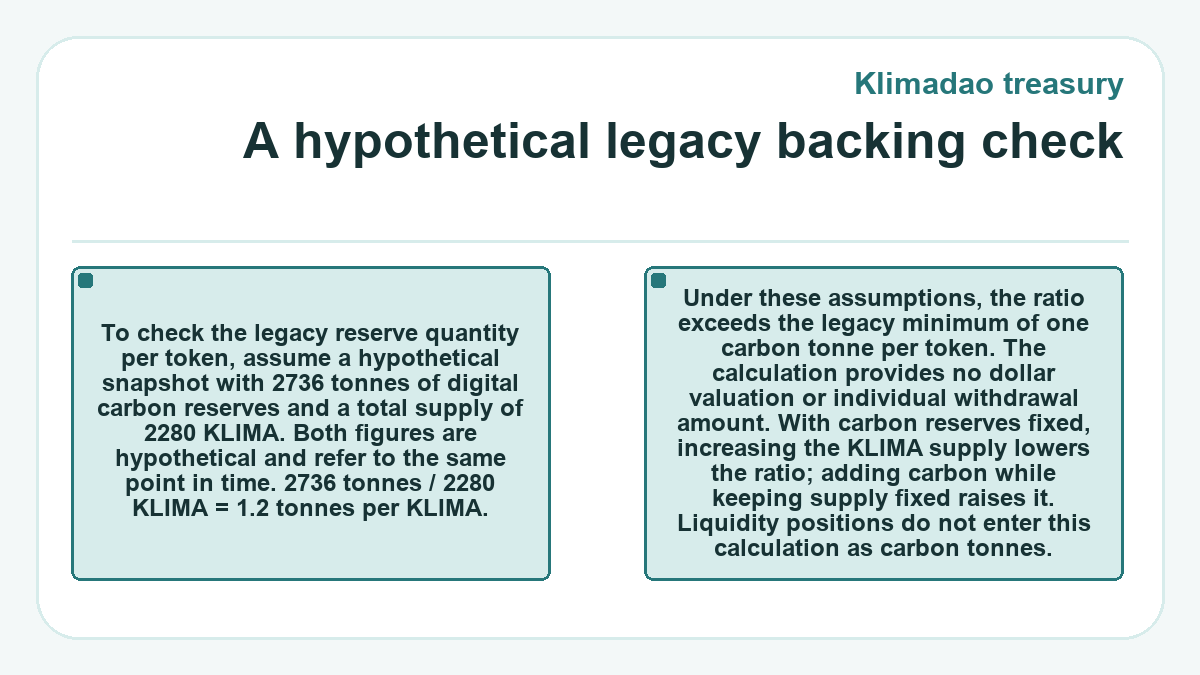
2736 tonnes / 2280 KLIMA = 1.2 tonnes per KLIMA
. Under these assumptions, the ratio exceeds the legacy minimum of one carbon tonne per token. The calculation provides no dollar valuation or individual withdrawal amount.
With carbon reserves fixed, increasing the KLIMA supply lowers the ratio; adding carbon while keeping supply fixed raises it. Liquidity positions do not enter this calculation as carbon tonnes.
Governance and access to treasury carbon
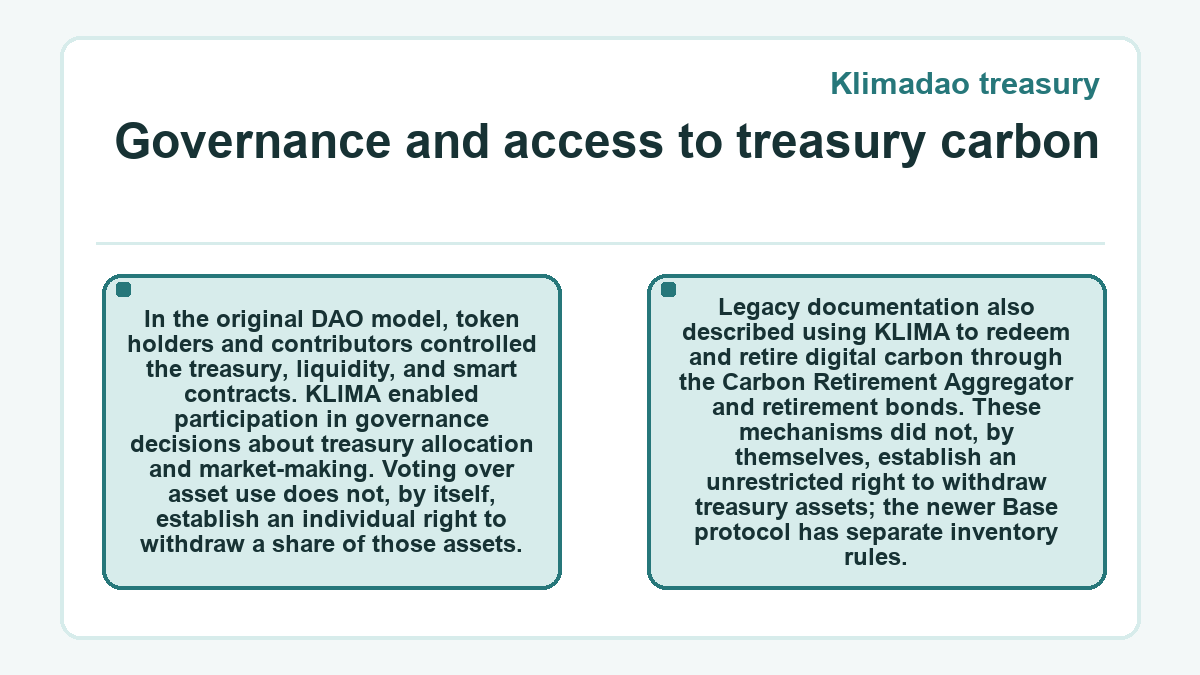
In the original DAO model, token holders and contributors controlled the treasury, liquidity, and smart contracts. KLIMA enabled participation in governance decisions about treasury allocation and market-making. Voting over asset use does not, by itself, establish an individual right to withdraw a share of those assets.
Legacy documentation also described using KLIMA to redeem and retire digital carbon through the Carbon Retirement Aggregator and retirement bonds. These mechanisms did not, by themselves, establish an unrestricted right to withdraw treasury assets; the newer Base protocol has separate inventory rules.
The newer inventory is reserved for retirement
The newer Klima Protocol on Base handles carbon solely to fulfill retirement demand. Credits supplied to that protocol are not available for withdrawal, resale, or secondary trading. Holding or locking kVCM or K2 grants no ownership claim or redemption right over protocol-held carbon.
Its governance handbook identifies kVCM as the unit of account and pricing reference for protocol-facilitated carbon retirement. Locked kVCM can signal pricing preferences and eligibility constraints, while locked K2 can signal capacity and stability preferences. These signals influence protocol parameters within predefined rules.
Participants who lock kVCM or K2, or deposit eligible liquidity positions into the protocol under its lock conditions, may receive protocol incentives. The protocol’s terms distinguish these incentives from interest, yield, or guaranteed returns and give participants no entitlement to protocol revenue or profits.
Last updated